Market demand for attractive visual content produced on a large scale has exploded. Consider a typical use case: a visual production studio faces operational inefficiencies and metadata errors, and struggles to implement real-time tracking. With a growing volume of images, it needs a more scalable workflow.
Its clients, retailers and e-commerce businesses, require a constant supply of accurate images, delivered quickly, but its growth still relies on a manual process, which creates technical challenges.
A fast-growing client base calls for an effective solution to improve workflow visibility, simplify metadata management, and integrate all systems in a unified production environment. ShotFlow, a visual production automation system, automates these manual procedures.
A rapidly changing production environment
The studio already uses partially automated systems, but finds it difficult to manage an experienced team and a high production volume simultaneously. Here are the main challenges:
1. Manual metadata entry: a source of errors
Metadata was essential for organizing and retrieving images, but also for distributing them correctly to customers.
- Every day, thousands of images were recorded manually, resulting in inconsistencies And expensive fixes.
- The smallest error could alter the accuracy of product sheets, directly impacting online sales and customer satisfaction.
2. Lack of real-time visibility into production flows
Customers needed quick access to track the progress of their content, but there were several hurdles:
- Lack of a centralized dashboard to visualize production steps, validations and file availability.
- Delivery delays due to a lack of status updates and the impossibility of following projects live.
3. Blocks in team collaboration
Working in silos between departments delayed the final delivery of content :
- Photography, Retouching, and Delivery Processes operated independently, creating inefficiencies.
- Files had to be moved manually, resulting in lost time and status errors.
4. Obsolete systems in the face of increased load
With rapid growth, the studio needed a solution that could manage several million files. without overburdening the teams.
- Managing files via folders became unmanageable with such a large volume of content.
- The teams were wasting precious time to find old versions of the files.
- A modern cloud solution was a must to ensure the rapid and efficient distribution of high quality content.
Transformation: Scalable Production Thanks to ShotFlow
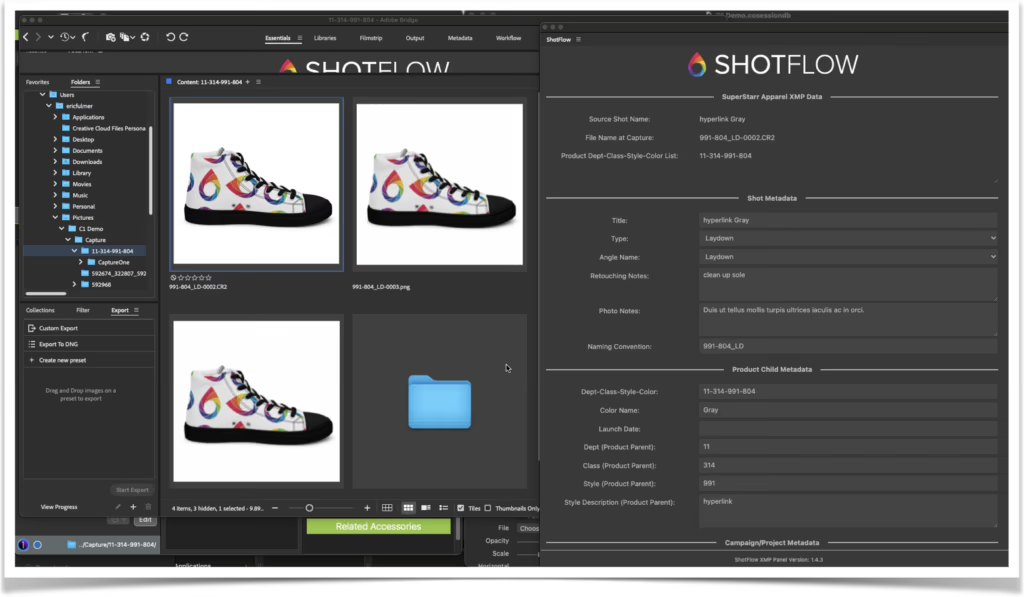
ShotFlow lets the studio reorganize its operations by automating workflows, optimizing metadata and integrating all systems.
1. Metadata automation: removing manual errors
The production infrastructure is configured to automatically apply metadata, which removes manual entry and the errors that come with it.
- Metadata templates adapt to each client's requirements.
- Images are automatically associated with product references (SKUs), brand specifications, and required formats.
- The metadata flow stays smooth, from shooting to final delivery.
Impact:
✅ Removal of unnecessary corrections, making the workflow more efficient.
✅ Easy file search and tracking for teams.
2. Real-time visibility: total transparency for customers
Thanks to ShotFlow dashboard, clients and internal teams get instant access to production tracking.
- Real-time tracking as soon as the files are uploaded.
- Automatic notifications on status changes, validations, and changes.
- Immediate viewing of images, allowing customers to reduce communication times.
Impact:
✅ Full transparency on content creation.
✅ Detecting and resolving bottlenecks before they cause delays.
3. System integration: a unified production pipeline
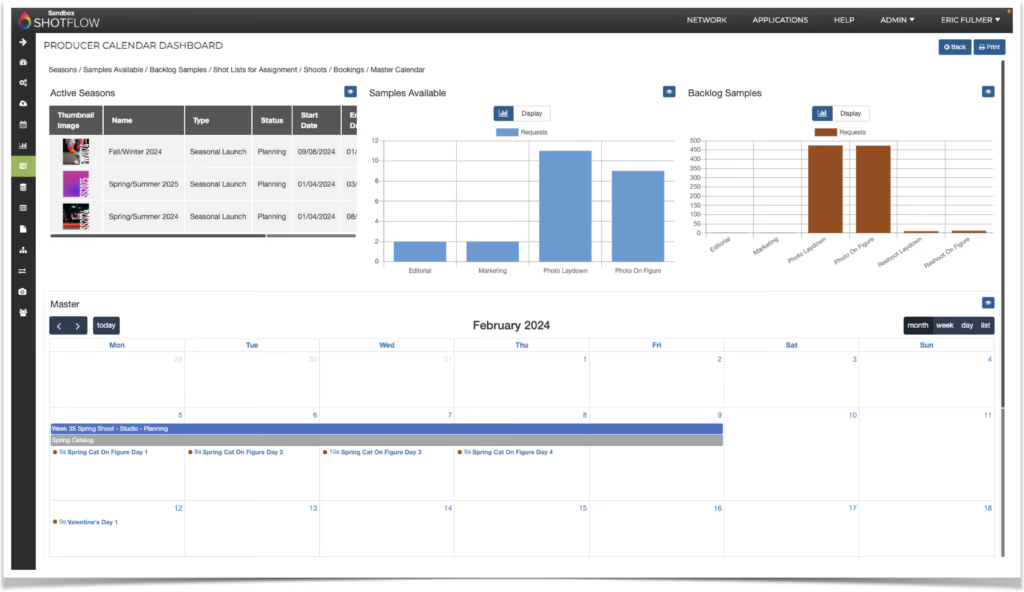
ShotFlow connects photography, post-production, and content management in a single integrated ecosystem.
- Metadata is automatically assigned as soon as the picture is taken.
- Retouching tools and file transfers are automated for a smooth process.
- The final distribution of the images to e-commerce platforms and clients is immediate.
Impact:
✅ A fully connected and seamless workflow.
✅ Precise metadata for faster editing
✅ Seamless delivery of final files.
4. Scalable production without bottlenecks
ShotFlow automation limits the need for extra staff to handle growing volumes.
- The integration of metadata, tracking and file routing helps absorb growth without friction.
- Onboarding new clients relies on standardized workflows.
- Large-scale content is processed automatically, which prepares the studio for a future expansion without difficulty.
Impact:
✅ Growth absorbed without reorganising production.
What the studio changed
With ShotFlow, a studio in this situation can structure its large-scale production around the following points.
Metadata accuracy:
✔️ Compliance with standards ISO 16684-1 for full compatibility with DAMs and e-commerce platforms.
✔️ Direct integration into Adobe Creative Cloud for instant access to creative tools.
Faster validation and customer satisfaction:
✅ Instant file validation online.
Scalability and the future:
📈 Sustained growth without structural overhauls.
🔗 A system that can manage huge volumes of content with a minimum of resources.