Your master file holds a photograph, information about its origin and, perhaps, a provenance manifest. After export, compression, a pass through the CMS and delivery via a CDN, what is left of that information in the image actually received by the customer or a marketplace?
For an e-commerce manager, the difficulty is not memorising every acronym. It is knowing which information must accompany which visual, for which destination, and then checking that it survives the technical journey.
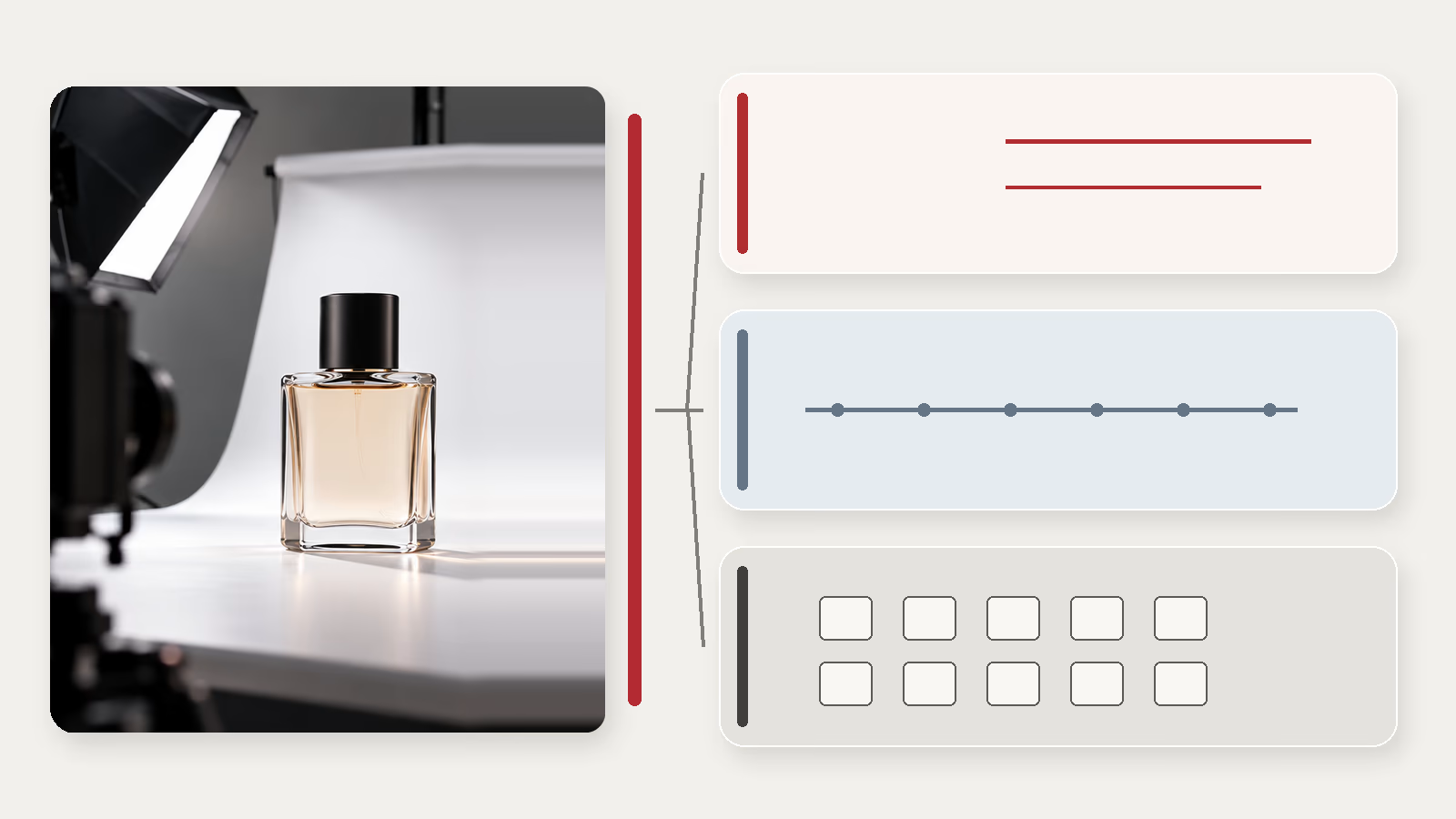
Sources consulted on 30 September 2026; Google and Zalando checked again on 6 October 2026. This article presents the rules, guidelines and platform policies available on that date. It is not legal advice. The header image is an AI-generated illustration.
Distinguish between the law, the platform and the standard
Three layers coexist without replacing one another.
- The European legal framework, notably Article 50 of the AI Act, divides certain transparency obligations between the provider of the AI system and, for deep fakes, the deployer. It does not impose IPTC, XMP or C2PA: the machine-readable marking required of the provider does not rely on any designated technology.
- The marketplace policy sets out the conditions for images sent to its service. A Google requirement is not automatically an Amazon or Zalando requirement.
- The technical standard defines how information can be stored in, or linked to, a file. An IPTC field, an XMP record and a C2PA manifest are not three synonyms for “AI label”.
Provenance metadata does not exempt you from the visible disclosure intended for the public, where that disclosure is due. Conversely, writing “AI-generated image” on a product page does not guarantee that the file sent contains the information requested by the platform.
Three platforms, three different checks
The points below reflect the policies consulted on 30 September 2026, and on 6 October 2026 for Google and Zalando. They are platform conditions, not three rules derived directly from the AI Act.
Google Merchant Center: the IPTC source type
As of 30 September 2026, Google Merchant Center Help asked that images created using generative AI contain the DigitalSourceType field with the value trainedAlgorithmicMedia. The same Help content asked that metadata embedded by generative tools not be removed, and cited other values to keep where they are already present, such as compositeSynthetic or algorithmicMedia. The French and German versions of the image requirements page list this retention among the minimum requirements, where non-compliance leads to the product being disapproved; as of 6 October 2026, the restructured English version deals with it in a separate section, without mentioning that disapproval.
The first check, then, is whether the image you send actually falls under this policy; the second is technical: is the value present in the final file, and not only in the working document?
Amazon: the narrow case of photorealistic synthetic people
As of 30 September 2026, Amazon’s documentation provided for the XMP keyword contains-synthetic-performer in the file’s keywords field for an image or video containing a photorealistic person entirely generated by AI, not inspired by a real person.
Amazon’s help page expressly distinguishes this case from real people, even when modified by AI, from non-photorealistic characters and from visuals with no person in them. A generated packshot showing only a bottle therefore does not receive this keyword simply because it is synthetic. To tell these techniques apart in production, see our article on invisible mannequins, virtual models and avatars.
Zalando: fidelity and its own image conditions come first
The guidelines updated on 1 October 2026, consulted on 6 October 2026, focus on a correctly represented product: patterns, textures, proportions, shadows, material and the model’s appearance. They do not allow a visible label to be added to the image, such as overlaid text or a visible watermark, and ask that no content be supplied that would require such a disclosure by law, such as deep fakes.
For invisible marking, the Zalando guidelines updated on 1 October 2026 carry the heading “required by December 2026”: they “strongly recommend” it for all AI-generated content, then ask for identifying data to be embedded in the metadata or as an invisible watermark, without naming a standard. As the page combines a recommendation and a requirement, reread the clause in force before any submission.
The final check must start from the platform’s policy and the type of file actually submitted.
IPTC, XMP and C2PA: what are they for?
| Term | Practical use in production | Limitation to be aware of |
|---|---|---|
IPTC Photo Metadata / DigitalSourceType |
Describing, among other things, the image’s source type using a controlled vocabulary. | Descriptive information is not an automatic certification of truthfulness. |
| XMP | A metadata structure that can carry IPTC fields or keywords such as those used by Amazon. | An export or a transformation can remove embedded fields. |
| C2PA / Content Credentials | Associating provenance statements with content by means of a signed manifest. | The manifest can be lost or separated as the file travels through the chain; additional binding mechanisms depend on how they are implemented. |
The Commission’s Code of Practice on transparency of AI-generated content provides for voluntary commitments by its signatories concerning several layers of marking. This voluntary commitment must not be confused with a universal technical obligation imposed on every photographer or every merchant.
Where can metadata be lost?
Think about the whole journey, not just the “Export” button:
Source file → retouching software → export → DAM or CMS → image transformation / CDN → file sent to the marketplace or served to the browser.
At each of these steps, check whether the file is simply passed on or re-encoded. A CMS may serve the master file at one size and an optimised variant at another size. The presence of metadata in the original file therefore does not prove its presence in the version actually displayed.
An example measured on our site on 30 September 2026, on the Vercel origin, outside Cloudflare: an AVIF image containing XMP and EXIF was served intact at widths of 640 and 1,080 pixels. At 1,920 pixels, for a request whose Accept header advertised WebP, the image was re-encoded as WebP, without that XMP and EXIF information; with the Accept: */* header, the original AVIF was served, metadata included.
This observation is limited to the file, the parameters, the origin and the date of the test. The behaviour of the www host behind Cloudflare was not measured in this check. It would be inaccurate to conclude that all CDNs, or even all of the site’s responses, always destroy metadata.
A simple check with ExifTool
These commands were tested on 30 September 2026 with ExifTool 12.76 on a JPEG file. Adapt them to the system and format you actually use; do not run them blindly on the only copy of your master file.
# Read the IPTC Digital Source Type field
exiftool -G1 -XMP-iptcExt:DigitalSourceType image.jpg

# Write the Google value for an image covered by the rule cited
exiftool -XMP-iptcExt:DigitalSourceType="http://cv.iptc.org/newscodes/digitalsourcetype/trainedAlgorithmicMedia" image.jpg

# Add the Amazon keyword in the specific case of a covered synthetic person
exiftool -XMP-dc:Subject+=contains-synthetic-performer image.jpg

# Check the recorded fields, including “Subject”
exiftool -G1 image.jpg
The right method is not simply to write a value and consider the matter closed: prepare a test file, put it through the same journey as your commercial images, retrieve the output and read it back. For C2PA, use a compatible tool capable of verifying the manifest and its signature; ExifTool does not replace that verification.
When C2PA can be useful
A signed provenance manifest can be useful in a chain where the tools support it, when a client asks for traceability information, or when it matters to keep information about how the visual was created. It guarantees neither that the product shown is truly faithful, nor that a transformed file will always keep its manifest.
The C2PA 2.4 specification, published in April 2026, describes among other things soft binding methods that can help recover a manifest maintained separately after transformation. This presupposes suitable infrastructure and implementation: do not promise this recovery in every case.
Before sending a batch, check five points
- Which policy exactly applies to this image category and this platform?
- Does the file sent contain the required fields, where they are actually required?
- Is any visible information that may be needed handled independently of the machine marking?
- Does the format, the size or the transformation service remove metadata?
- Do you have the file actually transmitted and a record of the check carried out?
Compliance cannot be inferred from a standard’s logo on a brochure. It is verified on the file and at its destination.
Sources
Sources consulted on 30 September 2026, Google and Zalando on 6 October 2026; platform policies change.
- AI Act, Regulation 2024/1689; Commission guidelines (content approved on 20 July 2026, formal adoption announced).
- Google Merchant Center, AI-generated images; preserving metadata; image requirements.
- Amazon, image guide; Amazon, generated person.
- Zalando Image Guidelines, updated on 1 October 2026, consulted on 6 October 2026.
- IPTC Digital Source Type, IPTC Photo Metadata, C2PA 2.4.