A dress photographed on a bust form that is then erased. The same dress shown on an entirely generated person. A photograph of a real model whose face has been replaced. These three visuals may be marketed under similar terms (“virtual model”, “ghost mannequin”, “AI fashion”), even though the operations involved and the transparency questions they raise are different.
For a product photography professional, the first step is to identify what was photographed, what was produced by software and whether an identifiable real person is involved. The fidelity of the garment or piece of jewellery is then checked separately.
Sources consulted on 30 September 2026. This article sets out the rules, guidelines and platform policies available on that date. It is not legal advice. The header image is an AI-generated illustration: the person wearing the blouse is entirely synthetic, not a real person.
The invisible mannequin (ghost mannequin) does not necessarily involve creating a person
The classic technique consists of photographing the garment on a bust form, then removing the form and completing the inside of the neckline from another shot. When done without an AI system, this composite does not fall within the scope of Article 50 of the AI Act merely because it is digital.
If an AI reconstructs the neckline, the edges of the fabric or the inner part of the garment, examine the changes that have been made. The name “invisible mannequin” is no longer enough to describe the result. Your priority checks are the cut, the collar opening, the seams, the volume and the visible details of the real item. The checkpoints are the same as for an AI cut-out that reconstructs part of the product.
Real person, altered person, entirely synthetic person
According to the Commission guidelines, a realistic AI-generated human avatar may be among the “persons” covered by the notion of a deep fake. This does not mean that every artificial figure shown in an online shop automatically receives the same characterisation.
| Technique used | Main question to address |
|---|---|
| Photo of an identifiable real person | Conditions of the shoot, of the use of their image and, depending on the case, of data protection. |
| Real photo heavily transformed by AI | Does the person remain recognisable? What transformation was authorised? |
| Entirely synthetic model, with no identifiable real person | Nature of the content, degree of realism, medium, audience and any transparency obligations. |
| Synthetic person derived from real photographs | Provenance of the source images and whether a person can be identified. |
| Clearly stylised avatar | Is the rendering likely to be wrongly perceived as authentic? |
The case of a photorealistic model in a still image on a product page is not explicitly settled by the official examples consulted. Claiming that “every virtual model must be labelled” would be an extrapolation; claiming the opposite would be one too.
The Commission provides, among other things, video examples: a realistic avatar of a company executive, simulated consumers in a teleshopping sequence, a synthetic influencer testing a sponsored product. These examples inform the analysis without resolving every situation that arises in a gallery of still clothing images.
Do not let the character change how the product is perceived
A virtual model can look convincing while altering the garment. The fidelity check must therefore focus on the item sold, not just on the aesthetic quality of the character.
A few useful points to check in a catalogue:
- Garment: actual length, cut, shoulders, waistband, drape, folds, sheerness, seam details.
- Footwear: silhouette, sole thickness, proportion on the foot, colourway and fastening.
- Jewellery: apparent size of a ring or earrings, length of a necklace, thickness of a bracelet.
- Accessories: is what is shown actually part of the offer?
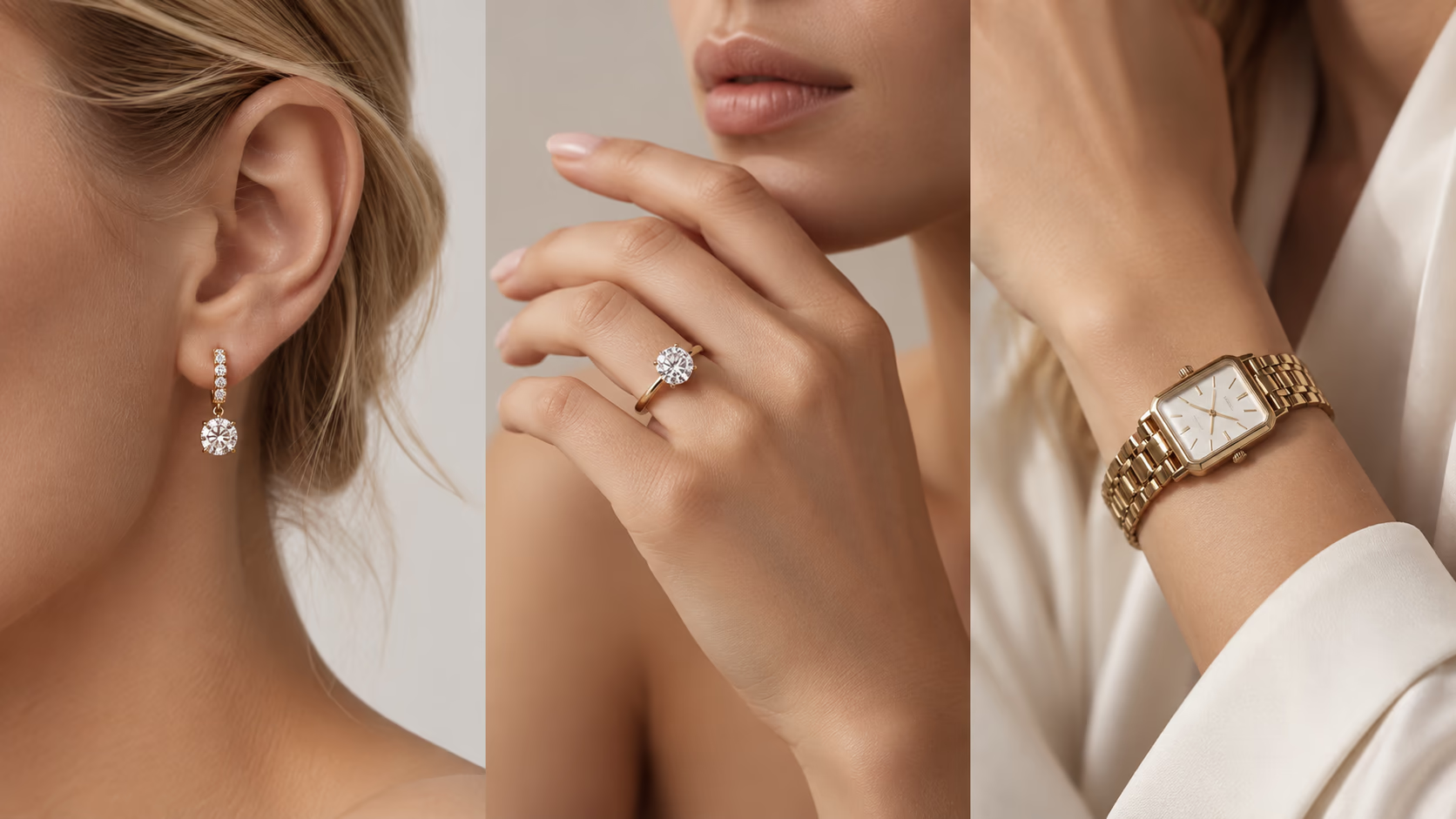
A beautiful image on a virtual model does not, on its own, prove that the product is faithfully reproduced. For sensitive elements, compare the published file with a real photo or with the product reference.
Try-on avatar: who supplies the images?
A virtual try-on based on a photograph of the customer raises a different question from a campaign created with a fictional character. The process may involve an identifiable real person; you then need to examine where the images come from, the intended use and the corresponding authorisations.
A model photo authorised for a given campaign should not be assumed to be freely reusable for every future generative composite. The extent of the rights depends on the context and the agreements; the sources consulted do not settle this point uniformly.
The commercial fidelity criterion, for its part, still applies: the avatar must not misleadingly alter the apparent size or the characteristics of the garment or piece of jewellery.
Synthetic influencer: telling still images and video apart
The Commission guidelines give the example of a video showing a realistic synthetic influencer testing a real sponsored product. This reference point should not be turned, without caution, into a conclusion that applies to every still image, every avatar or every carousel on a product page.
Rules specific to commercial influence, rules on depicting a real person and platform policies may also apply, depending on the use. They need to be analysed for the case actually produced, not piled up as if all generated fashion content automatically carried the same obligations.
In France, Law No. 2023-451 (Article 5) requires the statement “Images virtuelles” (“virtual images”) on commercial influence content that includes AI-produced images representing a face or a figure. Its application to a brand’s product page is a matter of interpretation.
The right production sheet
Before producing a collection of images on virtual models, prepare five elements: the photograph of the real product; a description of the technique used for the character; the provenance of any human images; the fidelity sign-off for each product reference; the distribution channels and the corresponding platform policies.
This way of organising the work lets the product team, the studio and the brand talk about the same image. It does not replace the analysis of the roles and obligations under Article 50, set out in our article on the AI Act and product images.
Sources
Sources consulted on 30 September 2026: Regulation (EU) 2024/1689; Commission guidelines on Article 50 (content approved on 20 July 2026, formal adoption announced); Commission FAQ; French law of 9 June 2023 on commercial influence (in French); guidelines from Amazon and Zalando.