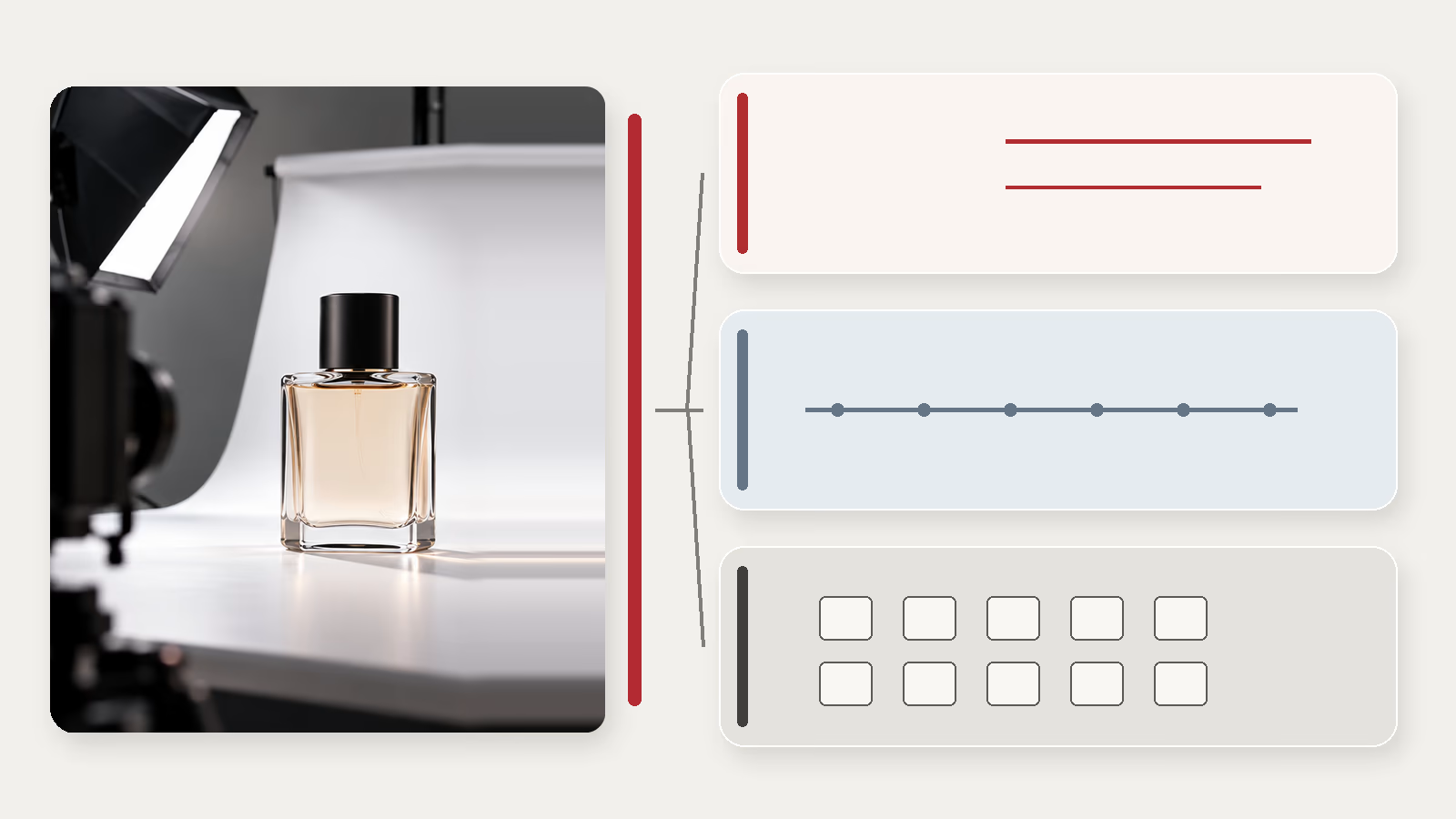
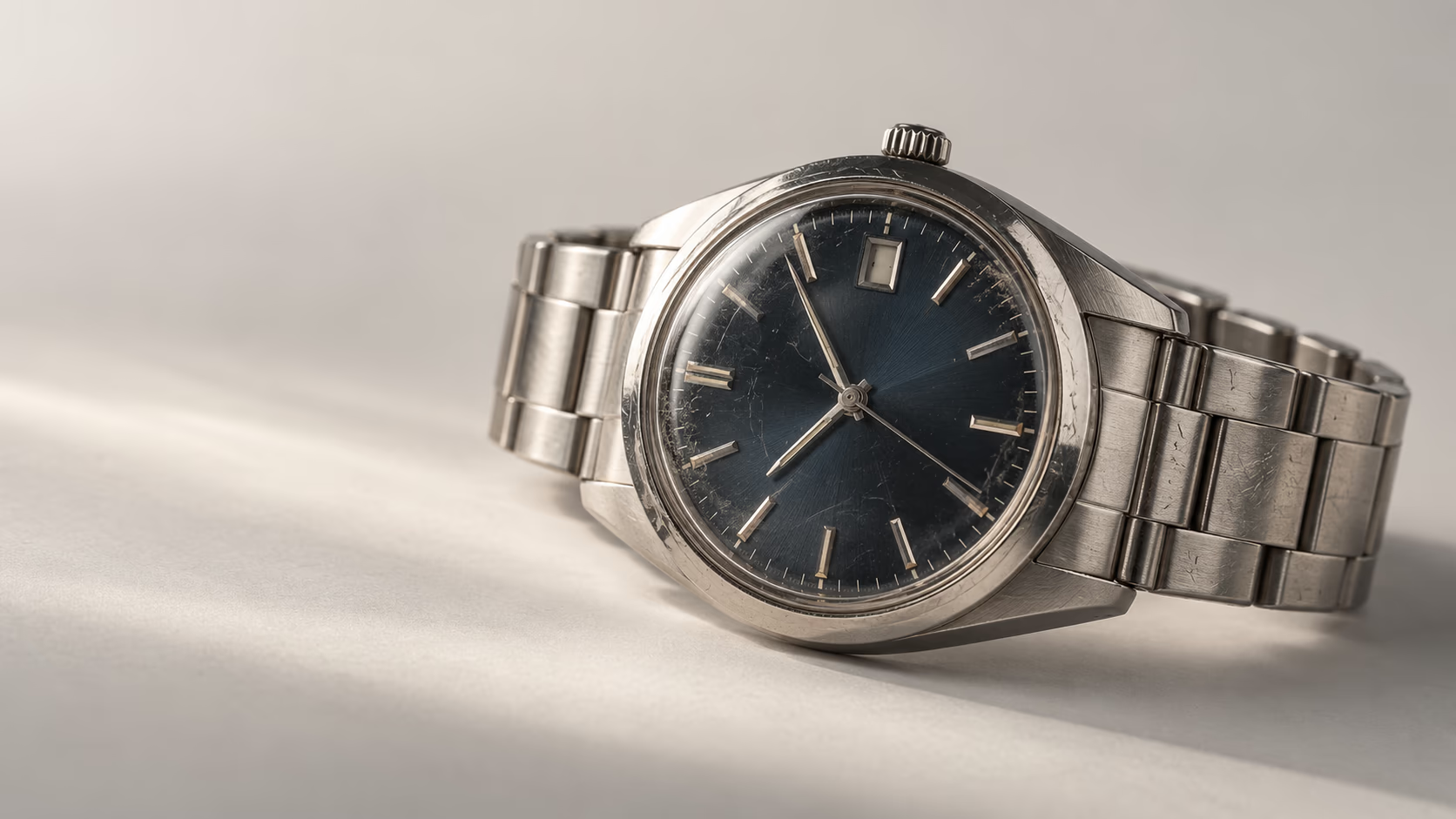
A bottle photographed on a white background, then cut out with AI. The same bottle placed in a generated setting. A third image, in which its colour and finish have been enhanced. These three visuals do not raise the same question under the AI Act.
Since 2 August 2026, Article 50 of the EU Artificial Intelligence Act has governed the transparency of certain content generated or manipulated by AI. It does not require an “AI” disclosure to be placed on every retouched photo. To know what to do, a brand must first establish who used the tool, what the image actually shows and whether it could be mistaken for an authentic representation of the product.
In e-commerce, the question is a practical one: customers are not just looking at an attractive image, they want to know what colour, what material, what accessories and what surface condition they will receive.
The essentials in one minute
- The tool’s provider, that is, its publisher, must mark the outputs concerned in a machine-readable format (Article 50(2)). The text notably excludes the assistive function for standard editing and cases where the tool does not substantially alter the data provided by the deployer, such as the original image, or their meaning.
- The brand that uses the tool under its own authority, as deployer, owes a visible disclosure when the image is a deep fake (Article 50(4)). This is a separate obligation from the provider’s: technical marking does not replace it.
- Removing a background visible in the original photo, slightly correcting a colour or removing sensor dust are among the examples of “standard editing” cited by the Commission: the tool does not have to mark these outputs.
- A real product placed in a generated setting is not automatically a deep fake. A product made to look different, more attractive or of better quality than it really is may, on the other hand, be one. An “AI-generated” disclosure does not make a misleading commercial presentation accurate.
- Several common cases are not settled by the texts consulted, notably the recolouring of a variant that is actually sold and the photorealistic virtual model in a still image.
- Google, Amazon and Zalando apply their own rules, separate from the AI Act.
Sources checked from 28 to 30 September 2026; European and Swiss texts, Google and Zalando checked again on 6 October 2026. This article sets out the rules, guidelines and platform policies available on those dates. It is not legal advice. The header image is an AI-generated illustration.
Two obligations, two parties
Article 50(2) targets the provider of the AI system: the party that develops it or has it developed, and places it on the market or puts it into service under its own name or trademark. It must ensure that outputs generated or manipulated by AI are marked in a machine-readable format (metadata, watermark or another process detectable by software). The regulation does not impose a single technology: it does not, on its own, make IPTC or C2PA mandatory.
Article 50(4) targets the deployer, which uses the system under its own authority: in principle, the brand or the online retailer. When the image is a deep fake, it must disclose that the image has been generated or manipulated by AI. Under Article 50(5), this information is provided in a clear and distinguishable manner, at the latest at the time of first exposure; according to the Commission, it must be perceptible without any technical tool.
A brand that simply uses a third-party tool does not become a provider on that ground alone.

Who must do what, depending on your situation
| You are… | What this changes | Role under the AI Act |
|---|---|---|
| Publisher of an AI generation or retouching tool marketed under your name | You mark the outputs covered by Article 50(2), except for standard editing or non-substantial alterations. | Provider |
| Brand or online retailer using the tool for its visuals | You add a visible disclosure to images that are deep fakes, under Article 50(4). | Deployer |
| Agency or studio using AI for a client | You are a deployer for your own uses. The client brand’s role depends on who decides to use the system and how (see below the table). | Deployer for its own uses (guidelines, points 12 and 14) |
| Marketplace that merely hosts the listing | Its own platform rules apply to your images. | Not a deployer for mere distribution, according to the Commission (guidelines, point 16) |
| Company that develops its own tool and uses it for its visuals | You may be subject to both the marking under Article 50(2) and the disclosure under Article 50(4). | Provider and deployer |
The agency case calls for clarification. According to the Commission, a brand that merely commissions an advertisement, without deciding whether or how the agency uses AI, is not a deployer; conversely, a company remains a deployer when service providers operate the system on its behalf, under its responsibility and control (guidelines, points 12 and 14). The intermediate case, that of a brand that imposes or closely governs its agency’s use of AI, is not explicitly settled by the texts consulted: the criterion remains who decides to use the system and how. In practice, set out in writing who decides on the use of AI, who approves the image and who publishes it.
Key takeaway: a file may contain technical marking without this replacing any visible disclosure the brand may owe.
Three dates to tell apart
| Date | What changes | For whom |
|---|---|---|
| 2 August 2026 | Article 50 applies, including the brand’s obligation to disclose deep fakes. | Providers and deployers |
| 2 December 2026 | End of the period for compliance with the Article 50(2) marking requirement for systems placed on the market before 2 August 2026 (Article 111(4), added by Regulation (EU) 2026/1744). This period does not postpone the brand’s obligation. | Providers of those systems |
| 2 February 2027 | Deadline set by the Code of Practice for an interoperability solution for watermark detection mechanisms. This is not a legal deadline. | Providers that have signed this voluntary Code |
And your older images? According to the Commission, images generated or manipulated before 2 August 2026 do not have to be marked or labelled retroactively. It encourages voluntary transparency where this can be implemented without disproportionate effort.
An AI retouch is not necessarily a new image
The Commission guidelines, which are non-binding, distinguish standard editing, which prepares an existing image for publication, from a substantial transformation. The Commission approved their content on 20 July 2026 (C(2026) 5054); it has announced their formal adoption, from which point they will apply, once all language versions are available. This adoption did not appear on its page as at 6 October 2026. On the standard editing side, they cite in particular:
- minor cropping, format conversion, compression;
- minor colour correction, brightening or darkening, standard colour and contrast adjustments;
- sharpening and noise reduction;
- removal of dust caused by the lens or the sensor;
- removal or masking of a background visible in the original file;
- edge completion and pixel filling to fit the format.
Conversely, they place the following among the changes to be marked:
- the removal, replacement or insertion of objects or persons, where they change the meaning and substance of the image;
- certain alterations of persons;
- extreme changes in brightness, colour or contrast that alter the meaning, intent or message of the image;
- composites that alter the representation of persons, objects, events or facts, and more generally substantial alterations.
The word “minor” matters. Correcting the yellow cast of a shot to recover the real shade is not the same operation as turning dark blue into red or making an object artificially shinier. A correction that does not bring the product closer to its real colour, but makes it more vivid or brighter than it is, cannot, in our reading, be presumed to fall within standard editing.

Background removal was reclassified in July 2026
The draft guidelines of 8 May 2026 classed the removal or masking of backgrounds among the changes to be marked. The version whose content the Commission approved on 20 July 2026 places them within standard editing, where the background is visible in the original file. This does not automatically cover generating a new background, nor reconstructing a handle, the transparent edges of a bottle or another part of the product.
Two practical rules follow. First, each operation is assessed, not the image as a whole: removing the background, then generating a scene, then enhancing the product’s material do not form a single legal category just because the same software did all of it. Second, what was done to the image is assessed, not the tool: the same software can produce standard editing on one image and a substantial alteration on another.
The practical check of each operation (edges, colour, defects, shadows, material) is detailed in our guide to AI retouching of a product photo.
The decisive point: what will the image lead the customer to believe?
The regulation defines a deep fake as AI-generated or manipulated image, audio or video content that resembles existing persons, objects, places, entities or events and could be wrongly perceived as authentic or truthful. Objects are expressly mentioned: a product can therefore fall within this definition. Intent to deceive is not required.
The guidelines (point 113) set out four cumulative criteria:
- an appreciable resemblance,
- to something that exists or could plausibly exist,
- concerning a person, object, place, entity or event,
- and liable to create a false appearance of authenticity or truthfulness.
The Commission’s FAQ, updated on 24 July 2026, presents the same requirements as three criteria, grouping certain notions together: these are not two competing tests.
Two Commission examples frame product photography:
- a real product shown in a generated environment, in an advertisement, is not a deep fake as long as the advertisement is not likely to mislead the public about the product, its characteristics or its use;
- a generated product image, in an advertisement or on packaging, is cited as a deep fake when it may mislead about the appearance, characteristics or use of the product, for example by making it appear non-identical, more attractive or of better quality than in reality.
The Commission adds that certain colour corrections, background extensions or replacements with a clearly aesthetic purpose and compositions of existing products probably have only a minor impact on the perception of authenticity. These examples concern advertising and packaging: transposing them to a product page is an interpretation.
Seven practical cases
For each image, ask two separate questions: must the tool mark the output, and must the brand add a visible disclosure? Where an answer rests on our interpretation, we flag it with “probably” or “in our reading”. Some cases are not settled by the texts consulted. A case that is not settled is neither permitted nor prohibited: it is a choice to be made, and documented.
1. Real packshot, without AI retouching
The product is actually photographed and the photo is used as is: it is neither generated nor manipulated by AI. The text is clear: no marking under Article 50(2), no disclosure under Article 50(4). If AI only adjusts the lighting or the shooting settings, without acting on the image itself, the case is probably out of scope.
2. Cutting out the studio background
When AI removes the background visible in the original photograph, the Commission classifies the operation as standard editing: the tool does not have to mark this output. On the brand side, a cut-out that keeps the product faithful is probably not a deep fake: removing the background does not, in itself, create a false representation of the product.
Take care with transparent products, textile fringes and handles: reconstructing their edges is an additional operation. Likewise, a new background, a generated shadow or a reconstruction of the product must be examined separately.
3. Recolouring: a variant you sell or a colour that does not exist
Only the blue bag was photographed; an AI produces the image of the red one, which is in the catalogue. The texts consulted do not settle this case, either for marking by the tool or for the visible disclosure by the brand. In our reading, this is not a simple colour correction: the final image represents a different item from the one that was in front of the camera.
Faithful rendering then becomes the starting condition. Recolouring can help out occasionally, but a recoloured image is not a photo of the real colourway: the exact shade, the texture and the way the material reacts to light may differ, particularly on textiles, as we explain on our fashion packshot page. Before publication, compare each recoloured variant with the real item or with a sample of the colourway sold, and keep a record of this comparison, of the approved version and of the person who approved it.
If the AI produces a colour that does not exist in the range and the visual presents it as available, the gap with the product sold is the first problem to examine. The Commission’s examples invite you to check whether the transformation is substantial and whether the presentation could constitute a deep fake, depending on the rendering and the context. Independently of the AI Act, the French Consumer Code (Code de la consommation) covers, among other things, misleading claims about the existence, availability or characteristics of the goods (Article L121-2). Adding “AI-generated” does not make the variant available.

4. Real product in a generated setting
A bottle that was actually photographed can be shown on marble, in a bathroom or in a landscape, all of them generated. The setting is generated content: the tool that produces it should probably mark it.
For the visible disclosure, the Commission gives the example of a real product placed in a generated environment, in an advertisement: it is not a deep fake as long as the image does not mislead about the product. Applying exactly the same solution to a product page remains an interpretation. The question to ask yourself: does the setting change what the customer understands about the product?

A purely decorative scene probably has only a minor impact. Do check, however, what it implies: the size of the bottle, accessories presented as included, water resistance suggested by the setting, the colour under the lighting, a use the product is not intended for. For these cases, the texts consulted do not explicitly settle the classification. A lifestyle visual should help people imagine the product, not invent characteristics for it.
5. Fully generated product
On the tool side, the answer is in the text: a photorealistic image of a product created entirely by an AI system is synthetic content, which the provider must mark.
On the brand side, if the visual makes the product look different from the real product, classification as a deep fake is probable. We base this on the Commission’s example of products made to look non-identical, more attractive or of better quality. And what if the generated image is strictly faithful to the real product? The texts consulted do not explicitly settle this case.
To judge this fidelity, do not compare two artificial images with each other: keep a reliable physical or photographic reference of the real product.
6. Defects or wear erased
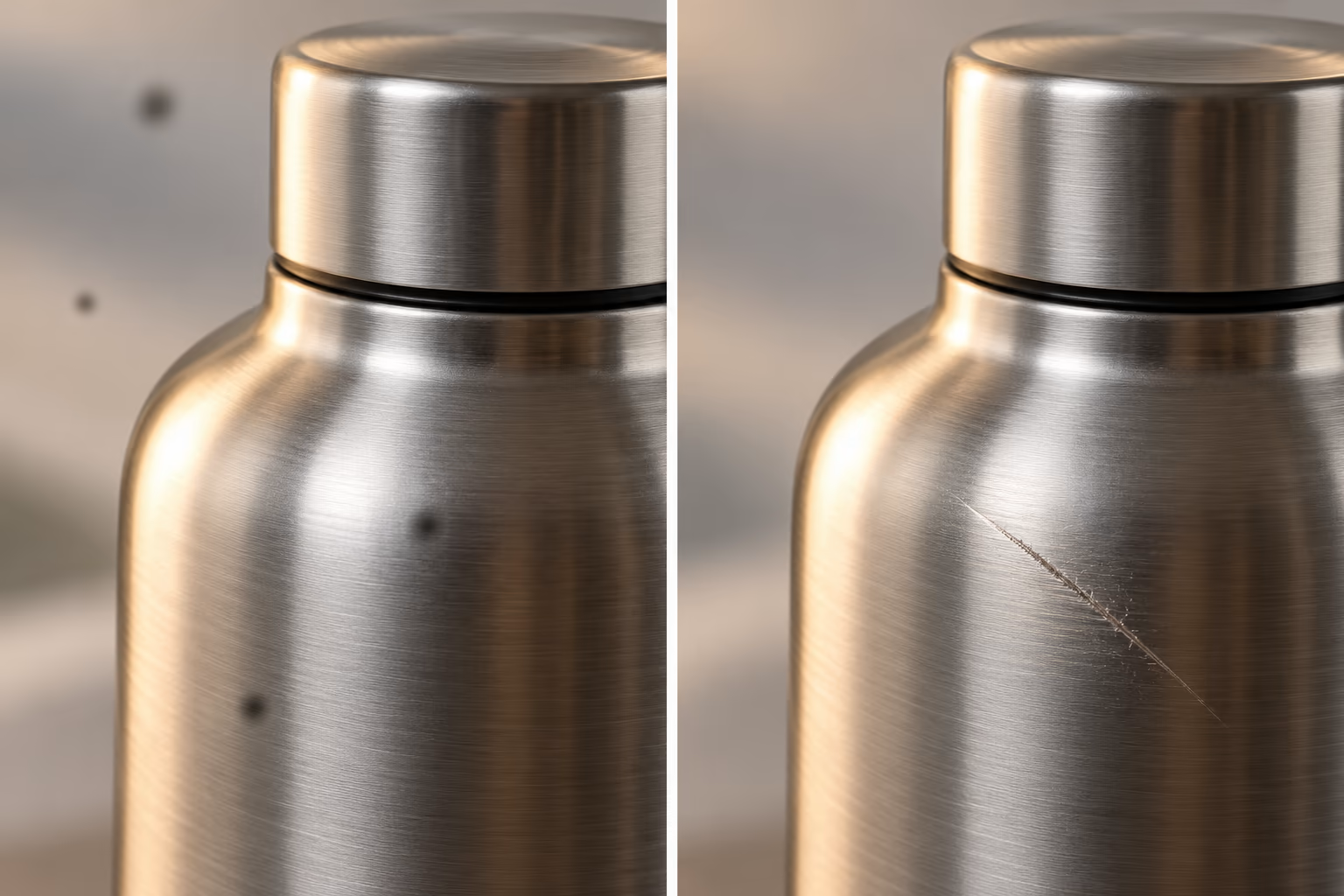
Removing sensor dust is not the same as erasing a scratch on a one-off piece. When AI adds, removes or replaces elements in a way that changes the meaning of the image, marking by the tool is covered by the Commission’s examples. For erasing a scratch or wear, however, the texts consulted do not explicitly settle the classification. In our reading, a practical distinction shows where the risk lies:
- new, mass-produced product: a scratch present only on the unit photographed takes the image further from the product delivered; erasing it brings the image closer to what the customer will receive;
- one-off piece, second-hand, refurbished, vintage: the condition of the object photographed is what is being sold; erasing it changes the information on the condition of the goods, which relates to their substantial qualities within the meaning of Article L121-2 of the French Consumer Code.
7. Photorealistic virtual model
A real dress worn by an entirely generated person raises two questions. For the tool, marking of the generated person is probable. For the brand, the texts consulted do not allow the conclusion that a photorealistic virtual model on a product page must always, or must never, carry a visible disclosure under Article 50(4). The case is not settled.
The guidelines give two pointers. They count realistic AI-generated human avatars among “persons”, and a person who could plausibly exist meets the existence criterion (point 113). But photorealism is not enough on its own: whether the image can deceive must be assessed, taking into account the context of dissemination and the audience (point 114). The Commission gives video examples involving synthetic persons; none concerns a product page. A voluntary disclosure remains possible; in our view, the choice made deserves to be documented. Beyond transparency, check that the garment is shown faithfully: drape, length, volumes, apparent size of a piece of jewellery. Related techniques (invisible mannequin, fully synthetic model, transformed model photo, try-on avatar) are told apart in our article invisible mannequin, virtual model, avatar.
Three related situations should not be confused with this one:
- real person transformed by AI: replacing a face or altering body shape or skin colour are among the changes the tool must mark, according to the Commission’s examples (point 92). In our reading, a realistic result meets the deep fake criteria. Whether the authorisation given for a photo shoot also covers these transformations is not settled by the texts consulted;
- identifiable real person: data protection and image rights apply, independently of the AI Act (points 127 and 129). In France, Article L2133-2 of the French Public Health Code (Code de la santé publique) requires the statement « Photographie retouchée » (“retouched photograph”) on a commercial photograph in which the model’s silhouette has been made slimmer or fuller using software;
- synthetic influencer: in a video, testing a real sponsored product, the Commission cites it as a deep fake; in a still image or a carousel, the case is not settled. In France, Law No. 2023-451 (Article 5) requires the statement « Images virtuelles » (“virtual images”) on commercial influencer content that includes AI-produced images representing a face or a silhouette; whether it applies to a brand’s product page is a matter of interpretation.

Other situations at a glance
For other common situations, this table gives the answer we have adopted. “According to the Commission” refers to an example in its guidelines; “probably” and “in our reading” flag our interpretation; an answer with no further qualifier follows from the regulation itself.
| Situation | Marking by the tool? | Visible disclosure by the brand? |
|---|---|---|
| Background replaced with plain white | Probably not: standard editing, no new content is generated. | Probably not. |
| Colour brought back to the product’s real shade | No, according to the Commission: minor correction. Limit: an extreme change that alters the meaning of the image. | Probably not: minor impact according to the Commission in advertising or on packaging, probably the same reasoning on a product page. |
| Sensor or lens dust | No, according to the Commission: standard editing. | Probably not. |
| Dust settled on the object during the shoot | Probably not: standard editing. | Probably not, if the dust is not part of the product sold. |
| Stray reflection removed | Probably not. If the AI reconstructs part of the object: not settled. | Probably not. If the retouch hides a real characteristic (finish, scratch): not settled. |
| Texture enhanced | Sharpening or noise reduction: no, according to the Commission. Invented material details: probably yes. | Sharpening or noise reduction: probably not. Invented details: not settled. |
| Shadow or reflection added | Conventional software: out of scope, no AI system. Realistic shadow or reflection generated by AI: not settled. | Conventional software: out of scope. AI generation for aesthetic purposes: probably not. |
| Invisible mannequin | Manual compositing: out of scope. Neckline reconstructed by AI: not settled. | Manual compositing: out of scope. AI reconstruction: probably not, if the garment is faithful and no person is simulated. |
| Try-on avatar | Probably yes, if the avatar or the image is AI-generated. | Stylised, clearly unreal avatar: probably out of scope. Photorealistic avatar: not settled. |
| Product video | Real video stabilised or edited by AI: no, according to the Commission. Video generated from a packshot, simulated consumers: yes, synthetic content. | Real video: probably not. Video generated from a packshot: in our reading, the same fidelity criterion as for a generated or altered product. Simulated consumers in a generated scene: yes, a deep fake according to the Commission. |
| 360° animation | Real photos assembled: probably out of scope. Intermediate views computed by AI: not settled. | Real photos: probably not. Views computed by AI: probably not, if they are faithful. |
An “AI” disclosure does not make an image lawful
Here the AI Act deals with transparency. It does not replace consumer law: an image that is correctly marked or labelled may still be misleading if it describes the product, its accessories, its availability or its condition inaccurately. In France, Article L121-2 of the French Consumer Code applies whatever tool is used. The Commission itself points out that the transparency obligation does not render lawful content that is otherwise unlawful.
AI Act, platforms and metadata: three sets of rules not to confuse
Platforms impose their own conditions on images generated or modified by AI. These rules are not restatements of Article 50: complying with a Google, Amazon or Zalando rule does not demonstrate that an image complies with Article 50, and vice versa. As at 30 September 2026 for Amazon, and 6 October 2026 for Google and Zalando, these three platforms follow three different approaches.
| Platform | Images covered | What to do | Visible disclosure |
|---|---|---|---|
| Google Merchant Center | All images created with generative AI | Make sure the image contains the IPTC DigitalSourceType metadata “trained | Optional (AI label setting); Google may add one itself in some cases |
| Amazon | Fully generated photorealistic persons, not inspired by a real person | Add the XMP keyword “contains-synthetic-performer” in dc:subject, before upload | Added by Amazon where applicable |
| Zalando | All generated content supplied by partners | Stay faithful to the product; do not supply content that requires a legal disclosure, such as a deep fake; invisible marking announced for December 2026 (see below the table) | Not allowed on the image |
For invisible marking, the Zalando guidelines updated on 1 October 2026 carry the heading “required by December 2026”: they “strongly recommend” it for all AI-generated content, then ask for identifying data to be embedded in the metadata or as an invisible watermark, without naming a standard. As the page combines recommendation and requirement, reread the clause in force before any upload.
For Google, the French and German versions of the help pages list the preservation of this metadata among the minimum requirements whose non-compliance leads to the product being disapproved; the English version, which has been restructured, deals with it in a separate section, without mentioning disapproval (pages consulted on 6 October 2026).
These requirements change: before exporting to a platform, check its current guidelines again rather than copying a universal “AI compliance” template. Also check that the expected metadata survives the publishing chain: a format conversion can strip it. Preparing the files and checking their path to the marketplace are covered in detail in our article on metadata for AI-generated product images.
Neither IPTC nor C2PA (a content provenance standard) is required by the regulation, and C2PA is not required by any of these three platforms. In our view, it remains useful when the generation tool already integrates it or a partner asks for it. On the brand side, metadata, which the public does not perceive, does not replace the visible disclosure of a deep fake (guidelines, point 117).
Penalties: ceilings, not a per-image scale
The text does not provide for an automatic fine for each improperly disclosed image. Infringements of Article 50 fall under Article 99, which sets ceilings: up to €15 million or 3% of worldwide annual turnover, whichever is higher. For SMEs, start-ups and small mid-cap enterprises, it is the lower of the two. The actual amount depends in particular on the nature, gravity and duration of the infringement, as well as on the size of the company.
In France, as at 28 September 2026, the list published by the Commission designates the Direction générale de la concurrence, de la consommation et de la répression des fraudes (DGCCRF, the French consumer protection authority) as point of contact, pending the final national designation. The bill intended to organise this enforcement, adopted by the Senate on 18 February 2026, is at first reading in the National Assembly.
A practical method before publication
For each image or series of images, keep a lightweight validation sheet:
- Original: keep the raw photograph or a documented physical reference.
- Operations: note what the AI did (cut-out, correction, recolouring, removal of an element, generation of a setting or a character).
- Fidelity: compare the final image with the product or variant actually sold.
- Roles: identify the tool used, who decides on its use, the studio, the brand and the distribution channel.
- Transparency: examine separately the marking applied by the tool and whether a visible disclosure may be needed.
- Platform: check the destination’s rules and whether metadata is preserved after export.
- Approval: submit cases that are not settled for approval and document the choice made; keep the approved file and the approval date, especially when several teams are involved.
This sheet is a way of organising production, not a register required by Article 50. Three questions sum it up: what was generated? what was modified? what does the image lead the customer to believe?
What if your company is in Switzerland?
Do not automatically equate EU obligations with Swiss obligations. Switzerland does not yet have general AI-specific legislation: according to the Federal Chancellery, the Federal Office of Justice is preparing a draft regulation that will be put out to consultation. No general Swiss obligation to label generated images has been identified, as at 28 September 2026, in the sources consulted.
The AI Act may, however, concern operators established outside the Union where the conditions of its territorial scope are met, in particular where the outputs of an AI system are used in the Union. For a Swiss company, how it applies in practice depends on the role played, the use of the system and the destination of the outputs. The Swiss rules specific to product images are detailed in our article “AI images and e-commerce in Switzerland: obligations, EU rules and marketplaces”.
Sources
Sources consulted from 28 to 30 September 2026; European and Swiss texts, Google and Zalando consulted again on 6 October 2026. Several sources are in English; quotations are translated freely.
European framework
- Regulation (EU) 2024/1689 on artificial intelligence, in particular Articles 3, 50 and 99 (EUR-Lex).
- Regulation (EU) 2026/1744, in particular Article 111(4) on the 2 December 2026 deadline (EUR-Lex).
- European Commission, Guidelines on transparency obligations for providers and deployers of certain AI systems, content approved on 20 July 2026 (C(2026) 5054), formal adoption announced once all language versions are available; non-binding.
- European Commission, draft guidelines submitted for consultation on 8 May 2026.
- European Commission, FAQ on the transparency obligations under Article 50.
- European Commission, Code of Practice on the transparency of AI-generated content, voluntary.
- European Commission, information on the EU labelling icons and on market surveillance authorities.
French law
- French Consumer Code (Code de la consommation), Article L121-2 (in French, Légifrance).
- French Public Health Code (Code de la santé publique), Article L2133-2 (in French, Légifrance).
- Law No. 2023-451 of 9 June 2023 to regulate commercial influence, Article 5 (in French, Légifrance).
- Bill containing various provisions for adaptation to European Union law: text adopted by the Senate on 18 February 2026 (in French) and bill No. 2518 (in French, National Assembly).
Switzerland
- Swiss Federal Chancellery, “Artificial intelligence” page (in French).
Platform policies
- Google Merchant Center, AI-generated content, Preserving metadata tags for AI-generated images in Merchant Center, Image link [image_link] and Use AI content label settings and disclosures in Merchant Center.
- Amazon Seller Central, Product image guide and How to tag media that contains an AI-generated person.
- Zalando image guidelines, updated on 1 October 2026, consulted on 6 October 2026.
Technical standards